
Introduction
Back in November last year, we published an extensive deep dive on Creotech Quantum — the planned spin-off from Warsaw Stock Exchange–listed Creotech Instruments (WSE: CRI).
At that time, CRI was trading at PLN 359 (19 November 2025). Our focus was primarily on the strategic implications of separating the quantum segment, but since then, developments at the parent company level have been equally noteworthy.
And they unfolded much faster than expected.
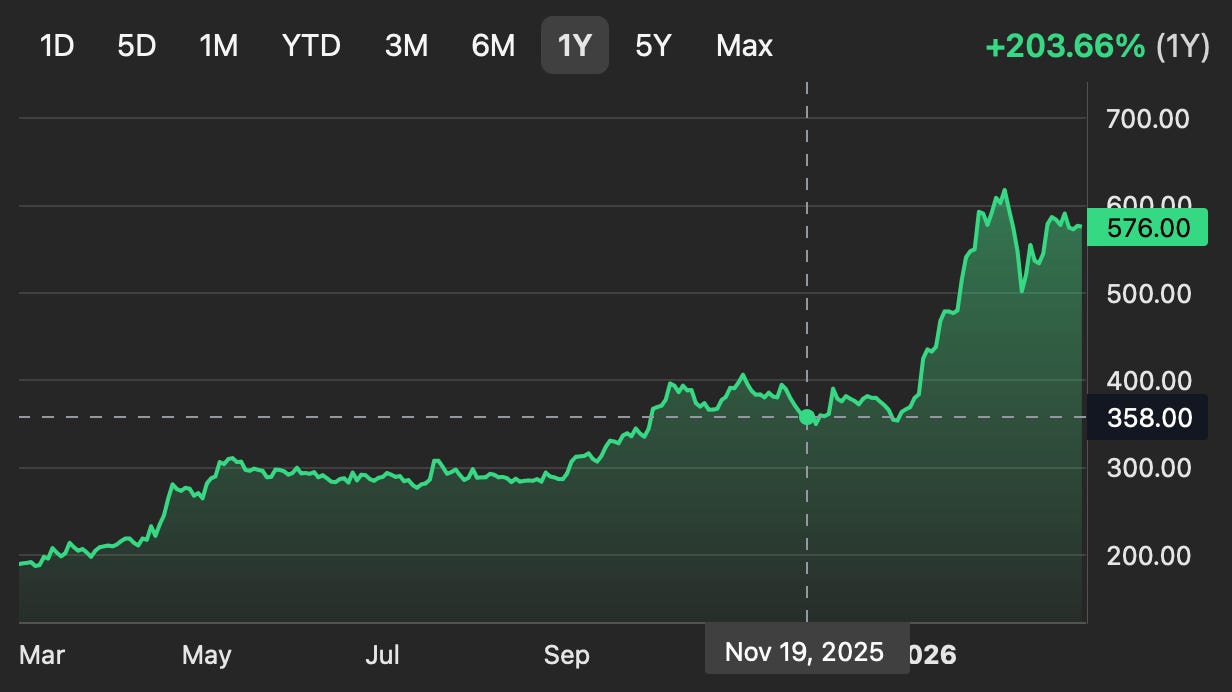
From late December onward, CRI began a strong upward move:
PLN 400 at the beginning of 2026
Above PLN 500 by mid-January
An all-time high of PLN 618 on January 30
Followed by a healthy correction toward ~PLN 500
And a rebound to nearly PLN 600 at the time of writing
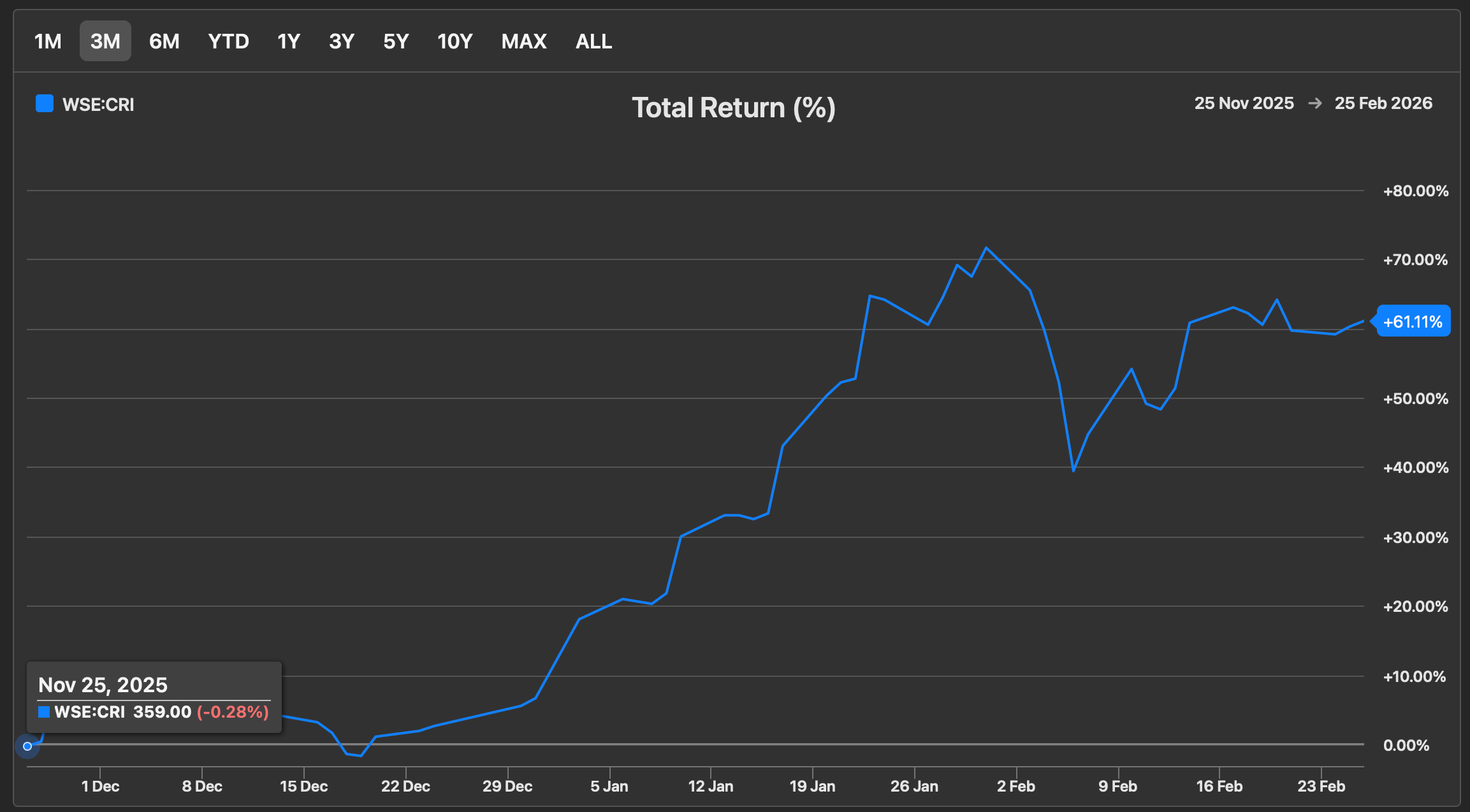
In less than three months, the stock delivered approximately +60% from the November reference point.
The 3-month total return trajectory is presented below (starting from 25 November 2025, PLN 359):
What surprised us was not the direction — the thesis was constructive — but the speed of repricing. Markets occasionally take years to recognize structural value. In this case, it took weeks.
This raises a natural question:
What exactly drove such a rapid revaluation?
Proof Over Promises
Between late November and mid-February, Creotech delivered an unusually dense sequence of operational and contractual milestones. The speed and quality of execution mattered — this was not one headline but a sustained stream of confirmations that reduced execution risk across multiple programs.
Below is a timeline of the most relevant developments since our November deep dive.
On 26 November 2025, the European Space Agency accepted project documentation under the CAMILA review. ESA acceptance is more than procedural; it confirms that technical deliverables meet demanding European Space standards, reducing execution risk in an ongoing international program.
On 29 November 2025, Creotech successfully established communication with three satellites of the PIAST constellation. PIAST is one of the company’s flagship programs. Establishing communication with all three satellites confirmed proper constellation functioning and demonstrated systems integration capability. This was a clear proof point of operational execution.
On 12 December 2025, the Polish Agency for Enterprise Development recommended grant funding of PLN 26,236,378, which is roughly USD 7.3 million at current exchange rates. This represents non-dilutive capital, strengthening the company’s R&D capacity without impacting shareholders.
On 18 December 2025, the Polish Armament Agency approved D1 documentation in the Mikroglob project. Completion of this milestone entitles Creotech to remuneration of PLN 51,706,851, or roughly USD 14.5 million. This was not just a technical step — it translated directly into contractual revenue.
Also on 18 December 2025, the European Space Agency partially accepted three additional milestones within the CAMILA project, further confirming ongoing execution.
On 19 December 2025, Creotech signed a contract for Phase A of a lunar orbital satellite mission titled “PHASE A FOR HIGH-RESOLUTION MINERALOGY MAPPER MISSION – EXPRO PLUS.” This expanded the company’s positioning beyond Earth-orbit systems and reinforced technological credibility.
On 8 January 2026, Creotech signed a contract under the project “Multi-purpose Quantum Key Distribution receiver for optical ground stations.” Financially, the contract was modest. Strategically, it was important because it directly connects to Creotech Quantum’s positioning in QKD infrastructure — the segment we analyzed in November.
Between 12 and 20 January 2026, the commissioning phase of the satellite platforms for PIAST-M, PIAST-S1 and PIAST-S2 was successfully completed. This effectively removed a major technical risk from the PIAST program. Markets tend to reward the reduction of execution uncertainty.
On 12 February 2026, Creotech signed a contract with ESA for the first phase of the “LEO-PNT – HyperSat SAFIR-PNT” project (EUR 500,000 total value, EUR 400,000 funded by ESA), acting as prime contractor.
The company considers this agreement strategically important, as it expands the application scope of its flagship HyperSat platform into the navigation satellite domain and may lead to follow-on contracts in subsequent mission phases.
On 13 February 2026, Creotech announced a strategic partnership with Eutelsat for secure satellite connectivity in Europe. Cooperation with a major European satellite operator materially strengthens the company’s strategic positioning within continental secure communication initiatives.
Taken together, this was a cluster of validation events: grant funding, defense-related milestone monetization, ESA confirmations, operational satellite commissioning, strategic partnerships, and visible progress in quantum-related infrastructure.
The market repricing was not driven by narrative alone — it was driven by delivery.
In capital-intensive, high-technology sectors such as space infrastructure, credibility compounds over time. Over a short period, multiple major projects transitioned from “planned” to “executed.” That compression of execution risk is the most rational explanation for the rapid revaluation.
A Potential Game-Changer the Market May Be Underestimating
Execution explains the repricing so far. But one development may matter even more for the medium term.
We believe the market has not yet fully recognized the strategic significance of the recently announced partnership between Creotech Instruments, Creotech Quantum and Eutelsat.
Creotech Instruments S.A., together with Creotech Quantum S.A., signed a strategic partnership agreement with Eutelsat, one of Europe’s leading satellite operators. The cooperation framework is focused on European secure satellite connectivity programs, with particular emphasis on IRIS² — the European Union’s flagship initiative for secure communications infrastructure with a total budget of EUR 10.6 billion.
IRIS² (Infrastructure for Resilience, Interconnectivity and Security by Satellite) aims to deploy approximately 290 satellites in low Earth orbit (LEO) and medium Earth orbit (MEO) to provide secure connectivity services for EU governments, public institutions, businesses, and citizens. It is a cornerstone of Europe’s effort to strengthen technological sovereignty and strategic autonomy in critical communications infrastructure.
Under the signed agreement, the parties intend to cooperate in areas including:
Development and adaptation of Creotech’s satellite platforms — including microsatellites and small satellites — to meet Eutelsat’s requirements for IRIS² communication missions and other European initiatives
Joint development of mission concepts, system architectures, and operational solutions aimed at increasing resilience, redundancy, and independence of Europe’s communication infrastructure
Potential involvement in both space and ground segments aligned with IRIS² architecture
The agreement also provides for an analysis of potential deliveries of space and ground subsystems, as well as complete systems, by Creotech Instruments and Creotech Quantum. This may include satellite platforms, avionics, secure communication subsystems, quantum components, and integration services. Key considerations explicitly mentioned are supply chain resilience, industrial scalability, and compliance with governmental and institutional requirements.
Importantly, discussions extend to collaboration in the field of quantum technologies and quantum-secured communications, including Quantum Key Distribution (QKD), Post-Quantum Cryptography (PQC), and hybrid security architectures for both space and ground segments. The intention is to jointly develop and test components and systems compatible with IRIS² and future European secure connectivity programs.
At this stage, the agreement constitutes a strategic cooperation framework and a letter of intent rather than a binding production contract. It does not yet translate into guaranteed revenue.
However, it formally positions Creotech and Creotech Quantum within the industrial dialogue surrounding one of the most significant European space infrastructure programs of the decade.
From a capital allocation perspective, this matters for three reasons.
First, it integrates Creotech’s HyperSat platform into a potential long-term European secure connectivity architecture.
Second, it connects the hardware segment with quantum-secure communications — directly relevant to the Creotech Quantum spin-off narrative. As the CEO of Creotech Quantum, Anna Kamińska, PhD said:
“Our cooperation with Eutelsat represents a unique opportunity for Creotech Quantum to develop and validate our solutions in quantum communications and cybersecurity. The IRIS² program enables us to demonstrate how quantum technologies can strengthen the resilience and autonomy of Europe’s critical infrastructure. At the same time, it creates opportunities for the growth of Poland’s space sector and local competencies, from design to system integration and testing. We believe our innovative approach will contribute to building secure, modern, and resilient satellite connectivity across Europe”.
Third, it anchors the company in demand segments tied to governmental and institutional security, which tend to be structurally more stable and strategically protected.
If execution follows and the cooperation evolves into concrete mission participation, this partnership could become significantly more important than its current financial footprint suggests.
Spin-Off Mechanics and Upcoming Listing of Creotech Quantum (April 17)
Creotech Quantum S.A. has published its prospectus (Source, PL only) in connection with the planned demerger of Creotech Instruments and the admission of its shares to trading on the regulated market of the Warsaw Stock Exchange.
The debut of Creotech Quantum is planned for 17 April.
The spin-off will transfer the organized quantum-related business segment — including all projects and intellectual property across QKD, PQC, Sinara quantum control systems, White Rabbit time synchronization, and advanced astronomical cameras — into Creotech Quantum as a standalone entity.
The transaction is structured as a demerger rather than a capital-raising IPO. Creotech Quantum will issue 2,854,347 new ordinary series B shares, which will be allocated exclusively to existing Creotech Instruments shareholders at an exchange ratio of 1:1.
For every one share of Creotech Instruments held, a shareholder will receive one share of Creotech Quantum, while retaining all existing CRI shares. No subscription, payment, or additional action is required.
As a result, the spin-off itself does not involve dilution or the raising of new external capital at the time of listing. However, as a growth-oriented technology company operating in capital-intensive segments, Creotech Quantum may require additional financing in the future to support scaling and commercialization.
From an investor’s perspective, there are two straightforward paths:
Become a shareholder before the demerger by purchasing CRI shares and receive Creotech Quantum shares via the exchange mechanism.
Wait until Creotech Quantum begins trading independently on or after 17 April and acquire shares directly on the market.
We do not speculate on short-term price behaviour following the listing. Spin-offs often experience volatility due to technical flows, portfolio adjustments, and initial price discovery dynamics.
However, it is worth recalling that the internal valuation of the quantum segment presented in the division plan implied a multiple materially below global peers operating in (somewhat) comparable quantum-adjacent domains. As discussed in our November analysis, the starting valuation appeared very conservative relative to the technological scope and strategic positioning of the business.
If market participants begin valuing Creotech Quantum as a specialized, pure-play quantum and secure communications entity — rather than as a bundled segment inside a broader space integrator — the repricing dynamics could become significant.
Whether that happens, and how quickly, remains to be seen.
- Michał Rzepka, CyberMoat
Uncovering risks, securing opportunities.
Disclaimer
This material reflects personal views and is not investment advice. Positions may be held in securities discussed.
Great read Michal!